
Where Fort Collins City Directories Survive
Fort Collins city directories are preserved through the History Connection, a collaboration of Fort Collins Museum of Discovery and Poudre Libraries. The useful unit is an annual volume, not one all-purpose resident list. A volume can be approached by name, street, business type, or rural address, so the source type matters when a search begins.
| Collection | Years | Publisher | Where Held | Access |
|---|---|---|---|---|
| 1902 Fort Collins City Directory | 1902 | Kelley & Carroll; Tribune Press contributor | History Connection ContentDM | Free scan and PDF item |
| Located local city-directory runs | 1902, 1903, 1904, 1906, 1907, 1908, 1909/10, 1910/11, 1913/14, 1917, 1919, 1922, 1925, 1927, 1929, 1931, 1933, 1934, 1936, 1938, 1940, 1948, 1950, 1952, 1954, 1956-60, 1962-64, 1966, 1968-73, 1975-77, 1979, 1980-present | Not verified for every year | History Connection and Poudre Libraries | Scanned except recent material noted below |
| Street Guide sections | Inside the annual volumes | Varies by volume | Same digital or print directory | Address-to-occupant reversal |
| Telephone books | 1927; 1964-77; 1980 onward | Not stated in the collection notes | Library and local-history collections | Partial gap substitute |
| Recent city-directory material | 2006-present | Not assigned without title-page proof | History Connection or library holdings | Ask about physical or less-searchable copies |
The run is uneven. No known Fort Collins city-directory volumes were located for 1941-47, and telephone books only partly fill that break. Collection notes say volumes before 2006 are scanned online, while 2006-present material may be physical or harder to search. Later publishers were not assigned because every title page was not verified.
The History Connection directory collection is the best first stop for checking a year, format, and scan before a library visit. It keeps the city directory evidence tied to a named local collection instead of a generic people-search result.
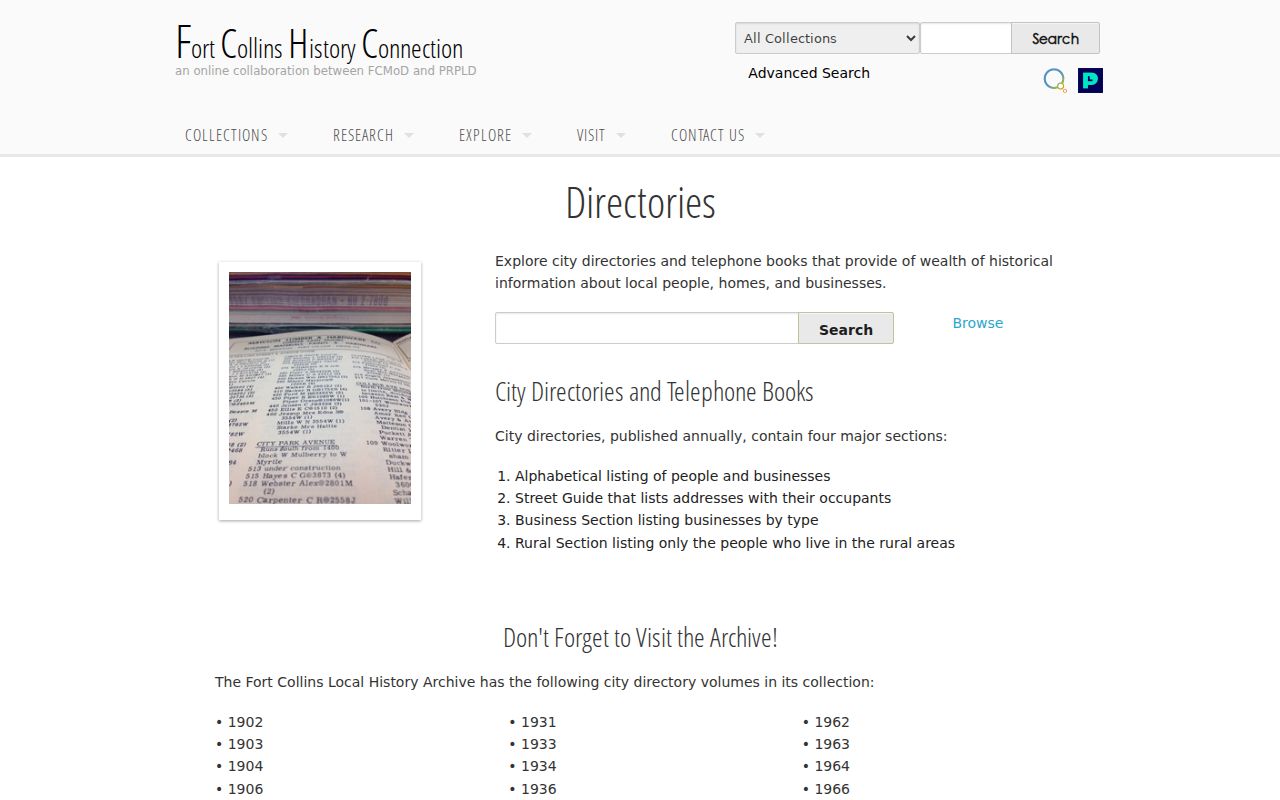
The collection view also makes the key distinction clear: a city directory, a Street Guide, and a telephone book may sit together while answering different questions.
The 1902 Fort Collins Directory
The 1902 Fort Collins City Directory is the strongest single object for grounding a city directory search. Its item record gives a title, year, publisher, contributor, call number, rights statement, and a link to the digitized text relationship. That provenance lets a researcher cite the volume rather than merely report that an old directory was found.
The digitized 1902 directory item identifies Kelley & Carroll as publisher, Tribune Press of Greeley as contributor, and call number 917.8868 Fort 1902. The rights field names the City of Fort Collins, and the item belongs to the ContentDM CityDirectories collection.
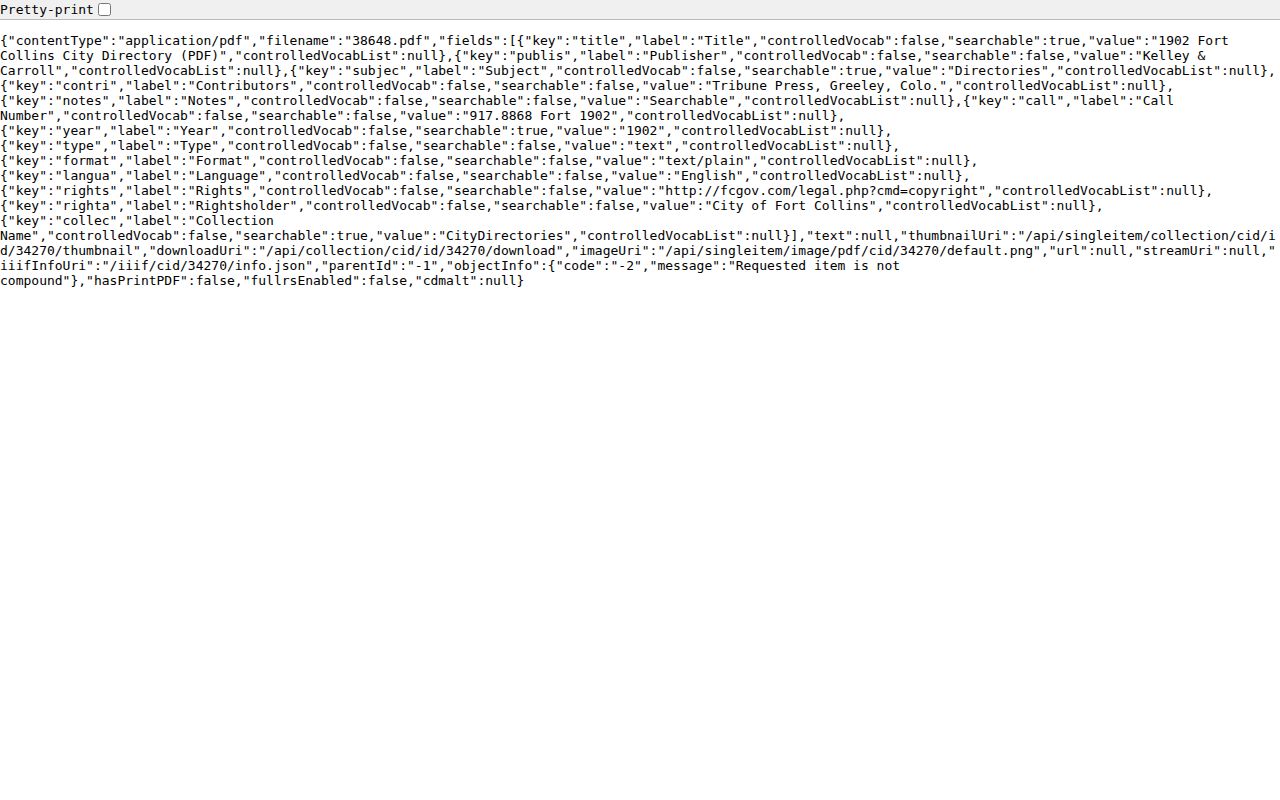
Use the item metadata as the citation, then inspect the scan for exact spelling, street form, and section. The research handoff did not transcribe a resident line, so no invented sample name belongs in a citation.
Four Sections in Fort Collins City Directories
A Fort Collins city directory is more useful when its four internal sections are searched in sequence. Match the question to a section, then use another section to test the clue.
- Alphabetical people and business names: the name-led entry may supply an address, occupation, spouse notation, or business tie.
- Street Guide: the address-led section lists streets, house numbers, and occupants, making a reverse search possible.
- Businesses by type: a proprietor or company can be found by category, but the result is an affiliation clue, not a home address.
- Rural section: farms and outlying residents can be missed by a city-street search.
The sections explain why one failed name search is weak evidence. A person may appear under a spouse, a business, a rural route, a preferred spelling, or a street entry. Search the same volume from a second direction before deciding that a household is absent.
Street Guide Reverse Search in Fort Collins
The Street Guide is Fort Collins' documented practical equivalent of a reverse or criss-cross directory. No separately titled Fort Collins criss-cross series was located. The address-first section inside the annual city directories supplies the local reversal: street name, number, and occupant rather than surname first.
Start with the period spelling of the street and the nearest available volume. Record the house number, occupant name, rural or city designation, and any abbreviation. Then flip to the alphabetical section to see whether the same name carries an occupation, spouse, or business clue. A Street Guide line shows historical placement for that volume, not proof that the same person lives there now.
Address clue. Preserve the printed street form before normalizing it, because a later rename can hide an earlier household.
Fort Collins Telephone Books and Gaps
Telephone books are a companion series, not interchangeable city directories. The located Fort Collins runs include 1927, 1964-77, and 1980 onward. They can supply a name and telephone listing near a missing city-directory year, but they may omit unlisted numbers, provide less occupation detail, and follow a different publication rhythm.
That distinction matters most for the 1941-47 gap. A telephone book can suggest that a name or household was reachable in a period, while a newspaper, census, cemetery entry, or deed supplies a second kind of evidence. Keep the book title and year in research notes so a telephone listing is not later mistaken for a full resident roll.
Reading a Fort Collins City Directory Entry
Older entries compress several facts into a line. Read the name, address, and historical occupation together, then check the volume's own abbreviation key. Initials, last-first order, spouse or widow notation, and boarding language can distinguish two people with the same name.
| Name | Surname, given name, initials, and possible spouse or widow notation. |
|---|---|
| Occupation or business | A period affiliation clue that can be checked against the business-by-type section and later filings. |
| Address | Printed house number and street, with the volume's own directions and abbreviations preserved. |
| Owner or renter mark | Copy a symbol only when that volume prints one and its key explains it; the mark is not verified for every run. |
| Spouse, widow, or boarding note | A relationship or household clue that should be compared with newspapers and census material. |
- Criss-cross directory
- An address-order directory used to reverse a street or house clue into an occupant. Fort Collins' Street Guide performs that role.
- Householder index
- An address-first list organized around household heads or occupants, when a volume provides that arrangement.
- Abbreviation key
- The volume's explanation of short forms and marks. Use it before expanding initials or turning a mark into a fact.
Tracing a Fort Collins Household Across Years
A household trail works best as a controlled sequence. Record what one volume says, then use the next source to test a move, death, relationship, or street change rather than filling a gap by guesswork.
- Begin with the nearest Street Guide volume and copy the exact street spelling, number, occupant, and city or rural section.
- Check the alphabetical section for the same name, spouse or widow notation, occupation, and alternate initials.
- Move forward or backward one located volume at a time. Treat a skipped year as an unanswered question, not proof of a move.
- Pair the directory with the 1885 Colorado census, 1870-1910 federal census material, the 1920 Larimer material, or Colorado 1930 access described by the library guide.
- Close a historical clue with a newspaper, cemetery result, deed, or permitted probate record, keeping each source's date and purpose separate.
A name can disappear because a household moved, a volume omitted it, a spouse became the listed name, or a person died. Newspaper notices and the Grandview or Roselawn grave locator can help separate those possibilities. When a historical find needs a present-day record check, the Fort Collins resident lookup uses a different evidence and privacy standard.
Fort Collins Library, Archive, and Newspaper Routes
Online access includes History Connection browse and search, ContentDM scans, the Poudre Libraries genealogy page, Colorado Historic Newspapers, Coloradoan coverage, CSU finding aids, the State Archives catalog, and cemetery GIS. In person, Old Town Library at 201 Peterson Street offers local-history help, while FCMoD Archive & Collections supports walk-in or appointment research at 970-221-6688 and archiveandcollections@fcmod.org.
State Archives access may be online, in person, by phone, or by mail, subject to its catalog and historical-age rules.
The Poudre Libraries genealogy and history route connects local databases, newspaper resources, cemetery information, and one-on-one help from the Larimer County Genealogical Society, usually Thursdays at Old Town Library from 1-3.
Newspaper access adds depth: Coloradoan online coverage is listed from 1999-present; Courier, Standard, and Express scans cover 1874-1923; local microfilm reaches 1874-present with a stated 1975-78 gap supported by Old Town microfiche. The Grandview and Roselawn grave locator turns a deceased name into a space and map clue. The Fort Collins Historical Society, CSU Morgan Library, and CSU Archives are referral routes for context, campus records, and special collections.
Fort Collins Directory Timeline
Dates provide a guardrail for a Fort Collins city directory search. The record story moves from paper land books and printed directories to scans, library indexes, and current digital catalogs, but each transition leaves a different gap.
| 1862 | Larimer land records reach back to this verified starting point, giving older house research a deed route outside the directory shelf. |
|---|---|
| 1902 | The verified Kelley & Carroll directory, with Tribune Press credit, anchors the digitized city-directory collection. |
| 1941-47 | No known city-directory volumes were located; telephone books and newspapers become the documented substitutes. |
| 1964-77 | Telephone books are listed for this period, but they remain a separate series. |
| 1975-76 | Tres Colonias lettered streets were renamed, so older and newer address forms need a bridge. |
| 2006-present | Recent directory material may be physical or less searchable even though earlier volumes are described as scanned online. |
The Tres Colonias change is a useful local story, not a minor spelling issue. Keep a before-and-after street column when tracing an address, then test the bridge in the Street Guide, newspaper notices, and city history material. The renamed street may explain an apparent break between two city directory entries.
Privacy Boundaries for Historical Fort Collins Residents
Historical does not mean every record is open. Colorado treats birth, death, adoption, marriage, and divorce records as confidential under C.R.S. §25-2-117, and those records are not an open online name index. Certified copies require the proper custodian, direct and tangible interest, identification, and relationship proof when applicable. A newspaper or directory clue can guide a request, but CORA cannot override the vital-record rule.
The Colorado State Archives describes a separate historical route that generally requires a record to be at least 100 years old. The published birth and death county lists inspected did not include Larimer, so the correct fallback is the library, History Connection, newspaper, cemetery, court, or eligible local application route rather than an invented open index.
Lawful research. A historical directory line can support genealogy, a house history, or a permitted family inquiry, but it is not permission to stalk, harass, or intimidate anyone.
Use the original custodian for corrections, protected records, and certified copies. Keep an old entry labeled with its year and source, and never turn a historical appearance into a claim about a living person's current address.